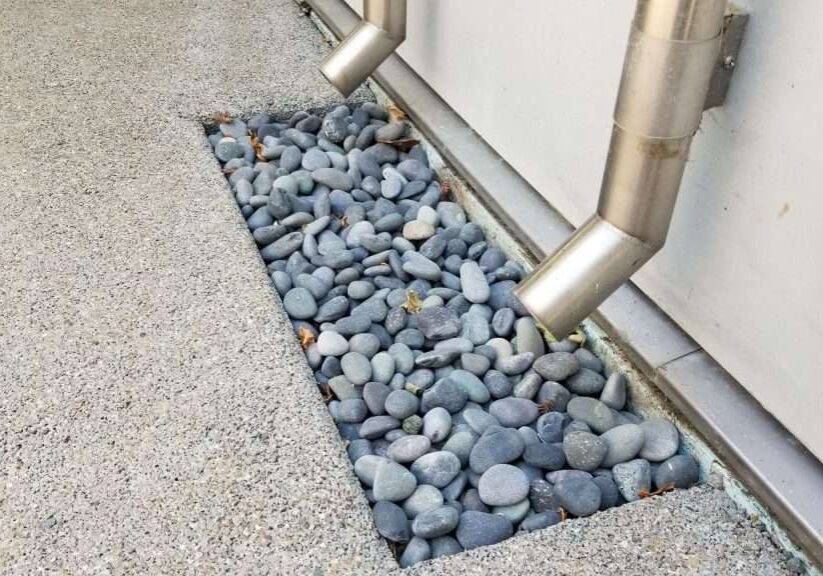
Fundamentally, what is most exciting about permeable concrete is that we’re returning land to a pre-developed hydrology, while maintaining a useful hard surface that we can work, play, and drive upon. The rain that falls on AquaPave® can again soak into the ground instead of flowing across a hardscape where it picks up contaminants, and then degrades the nearest body of water with polluted runoff.
Sand is not Required
AquaPave® permeable concrete does not require sand. In fact, the 20% sand content of conventional concrete is replaced with a 20% void content through which stormwater flows back into the ground. By choosing to place AquaPave® you will be supporting the preservation of New Zealand’s precious beaches and native habitats.
Remove Pollution
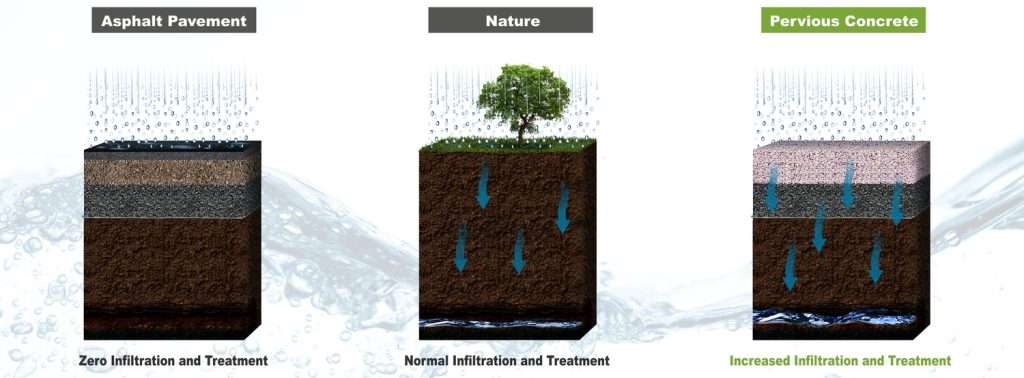
When rain soaks into the ground, not only does it recharge groundwater and local aquifers, but it also filters out stormwater contaminants. Our basecourse contains native microbes that metabolise approximately 98% of all polycyclic aromatic hydrocarbons (oil, petrol & diesel). In addition, the AquaPave® system filters up to 97% of heavy metals, 82% of phosphorus and 40% of nitrates from stormwater passing through it.
Get a Free Estimate
leave a message using the form below
Contact
Water Recapture for Urban Trees
When planning for landscaping, AquaPave® provides a way to safely pave much closer to existing trees, because air and water are readily supplied to their roots. Trees planted adjacent to permeable concrete have been shown to experience a growth rate 68% greater than that of trees in traditional concrete plots. Furthermore, the resulting grey water can be harvested for irrigation.


Reduce the Heat Island Effect
Permeable concrete is a cooler pavement than traditional pavements. The air and water exchange from the surface of the pavement to the sub-soil beneath keeps the permeable concrete slab cooler. This also reduces the heat island effect of dense development.
Strengthen Native Hydrology
In cases where native soils may infiltrate slowly or quickly saturate, permeable concrete can outperform nature for the amount of stormwater that it can infiltrate and treat, thus providing increased hydrological benefits.
Reduce Embodied Energy and Carbon
Reducing embodied energy and carbon are considered key priorities in the goal to reduce climate change. The consumption of portland cement, a key ingredient to concrete, accounts for almost 10% of all human-generated carbon emissions annually. Permeable concrete uses less portland cement per volume than conventional concrete, and can reduce a pavement’s embodied carbon by almost 40%. The additions of industry by-products produces a 64% reduction of embodied carbon per volume. When compared to asphalt, permeable concrete requires less energy to be produced, leading to a 56-70% reduction in embodied energy at the time of installation.